















A New Income Category
The official reclassification of the Philippines as an Upper-Middle Income Country (UMIC) by the World Bank on July 1, 2026, is a major economic milestone that has been almost four decades in the making. The upgrade is in line with the gradual increase in the country’s Gross National Income (GNI) per capita to $4,850 in 2025 above the World Bank’s threshold of $4,636 for the current fiscal year. This achievement places the Philippines alongside other developing economies that have shown sustained economic growth and better macroeconomic management.
Comprehending the GNI Metric
These income groups are mainly based on the GNI per capita, which the World Bank calculates using its Atlas method. The average income of the residents and businesses of the country, both at home and abroad, is measured by it. Proponents of the classification see it as a confirmation of the government’s economic policies, broad-based growth across industries and the overall resilience of the Philippine economy. The Department of Economy, Planning and Development (DEPDev) has emphasized this reclassification as a reflection of successful reforms and solid economic performance.
Income Gap Remains Wide
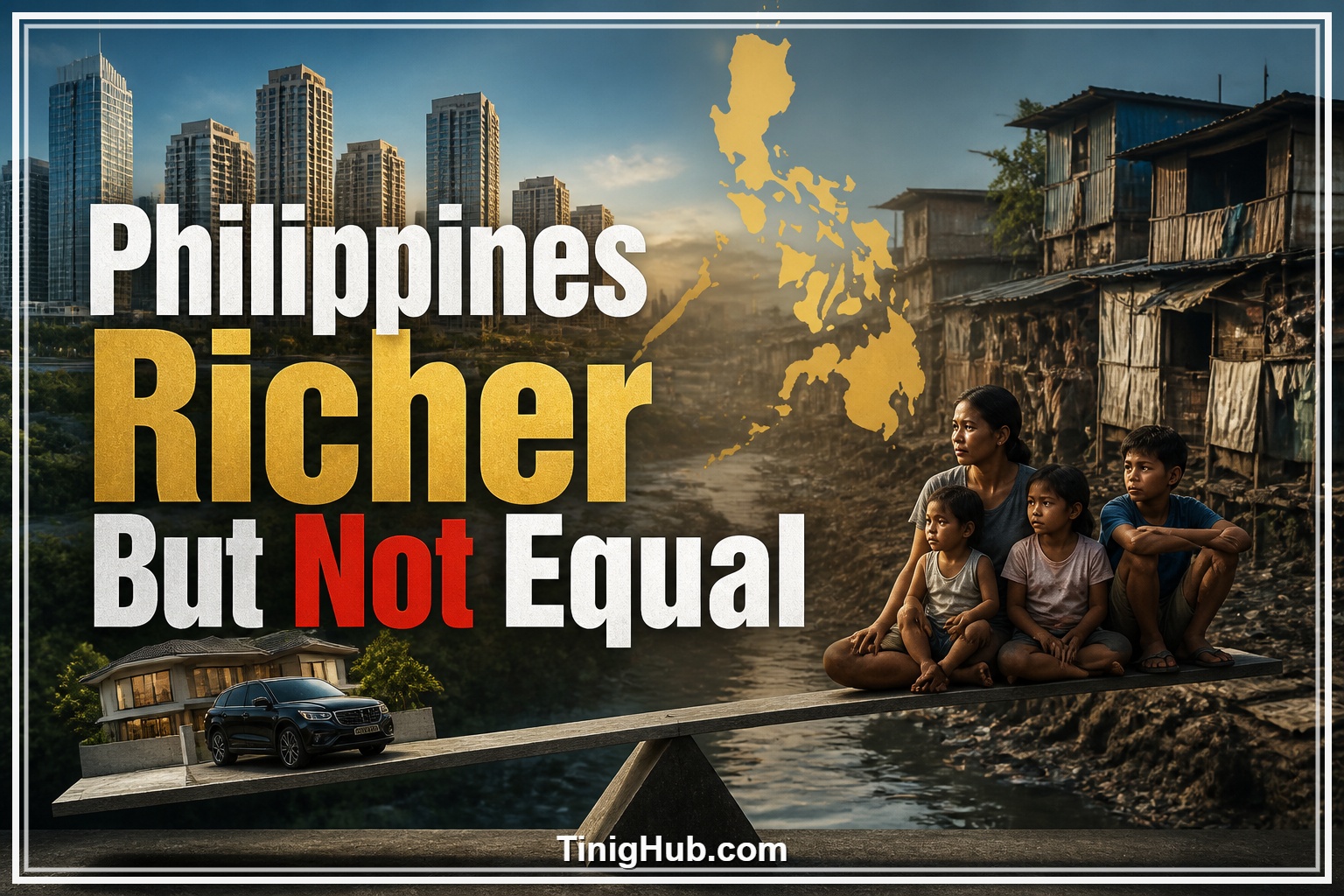
But the celebratory mood of this reclassification comes with a critical analytical lens on its real impact on the ground. GNI per capita is an average, and does not by itself take into account the distribution of wealth or income within a country. This is an important point that is often downplayed. The IBON Foundation, a critic of the UMIC status, says the status is “meaningless” for a big segment of the population. It said around 15 million Filipino families are still poor and another 7 million are lower middle class. This means that while the country has become wealthier, it has not trickled down to the 111 million Filipinos equally.
Chronic Poverty and Inequality
Although macroeconomic gains are present, data from institutions such as Social Weather Stations indicate that the self-rated poverty rate may have even increased under the current administration, which further raises doubts on the immediate positive impact of the reclassification on ordinary citizens. Studies have also named the Philippines as one of the most unequal countries in the world, with the widest gap in Southeast Asia. This ongoing economic and social inequality means that wealth, opportunity, and infrastructure are still held by a small group of people, with many families facing high prices, low incomes, and limited opportunity.
Implication for International Assistance
The new UMIC status has practical implications for the Philippines’ relations with international financial institutions. Historically, lowermiddle income countries are eligible for more concessional loans and official development assistance (ODA) The Philippines, as an upper middle income country, may eventually see a decline in access to some of these preferential funding mechanisms and some scholarship programmes. This is a natural consequence of economic progress, admits Finance Secretary Frederick Go but some economists note a sharp cut in aid may not be imminent, as eligibility for some facilities tapers off at a higher GNI per capita level, usually about $7,000.
Tackling the middle-income trap
The “middle-income trap” is now the big challenge for the Philippines. This economic phenomenon happens when countries hit middle income but then have difficulty reaching high income, often because of a failure to implement other structural reforms, to spur innovation, or to invest enough in human capital and advanced industries. It is considered essential to make continuous and substantial investments in manufacturing, innovation, education and technology to get out of this trap. However, economists cautioned that the Philippines is currently at the lower end of the UMIC threshold, and sustained and inclusive growth strategies are key to prevent a possible reversal of status.
Structural Issues Persist
Deeply rooted structural problems also make the journey to truly inclusive and sustainable development more difficult. These include an oligarchical political economy, where political dynasties and powerful family-linked conglomerates may influence policy decisions in a way that perpetuates inequality. Weak redistributive institutions and development models that prioritize visible and profitable growth over equitable inclusion compound the problems. External factors also pose further headwinds to the long-term sustainability of the country’s economic trajectory, including the escalation of climate-related risks and global trade uncertainties.
A Call for More Reforms
The reclassification to UMIC status is a major achievement at the national aggregate level but it is a benchmark of economic capacity and not a comprehensive report card on the quality of life for all citizens. It highlights the urgent need for the government to look beyond headline growth numbers and undertake bolder, more inclusive reforms. That calls for tackling inflation, boosting social protection systems, investing in critical infrastructure, encouraging fair competition and making sure that economic opportunities are available to all parts of society, especially those in underserved rural areas. The analytical lens reveals that the vaunted status is but a milestone, requiring renewed efforts to ensure economic gains translate into concrete improvements for every Filipino.